The Only Consciousness Explainer You’ll Ever Need
Consciousness is the forward rollout of your existing perception simulation.
If I sit at my desk and imagine a jet airplane, my physical body has to enter a different state that produces the experience of seeing a jet airplane despite there being no jet providing the corresponding visual input. Neurons change electrical state inducing chemical signals to propagate and engage neuronal populations involved in visual perception to change their activity. There is no abstract image floating somewhere waiting for consciousness to look at it. My nervous system physically rearranges its current state until part of the machinery responsible for constructing vision is producing the experience. That is a textbook hallucination.
The same process works the same way during ordinary perception. Your brain generates states corresponding to what it expects to encounter, receives sensory information, reconciles the difference and generates the next state. Most of the time the generated state remains sufficiently constrained by the external world that the distinction is invisible. You experience the result as reality.
I have described the underlying computational model as stream inference since 2016: model a stream, forecast its continuation, reconcile the forecast against subsequent input, update the model and continue.
Consciousness is the physical rollout of that process: You are hallucinating the world and that hallucination is consciousness.
Hallucination is a physical process
People use hallucination as an epithet for information that is wrong, and recently, novices love to focus on this when discussing generative AI.
A hallucination is something a physical system does. Internally generated visual imagery in the central nervous system recruits neural machinery also involved in externally driven perception. Motor systems enter measurable states corresponding to actions before those actions occur. During dreams, an experienced world continues despite the dramatic reduction of sensory constraint that normally keeps visual experience coupled to the environment. These are physical states of nervous systems consuming energy and changing electrochemical activity through biological tissue.
The distinction between ordinary perception and what we conventionally call hallucination is mostly a distinction in external constraints. In waking perception, internally generated states are continuously corrected by sensory information and by the consequences of acting in the world. A dream removes much of that external correction. Psychedelics perturb the dynamics generating the state. A conventional hallucination is noticeable because the generated experience has diverged sufficiently from its external constraints.
The nervous system still has to physically produce the experience in every case.
So you’re begging to know why does any of this feel like something?
Because the forecast is instantiated through the same perceptual system. The brain does not have some special space to calculate that you are likely to see red, send that proposition somewhere else to some computing area offline and wait for the consciousness center to render it as an experience of red. The entire biological system of your body generates a physical perceptual state that includes the experience of the social construct of "red."" The internally generated data stream is an instantiation of the hallucination being predicted through overlapping perceptual machinery.
There is a simple electrical trick that demonstrates what I mean. Connect a hand crank to a small generator and turning the crank produces electricity that can charge a battery. Reverse the arrangement and let the battery send electricity back through the same device, and the crank turns. The machinery that encoded the movement into an electrical state can be driven by an electrical state to reproduce the movement.
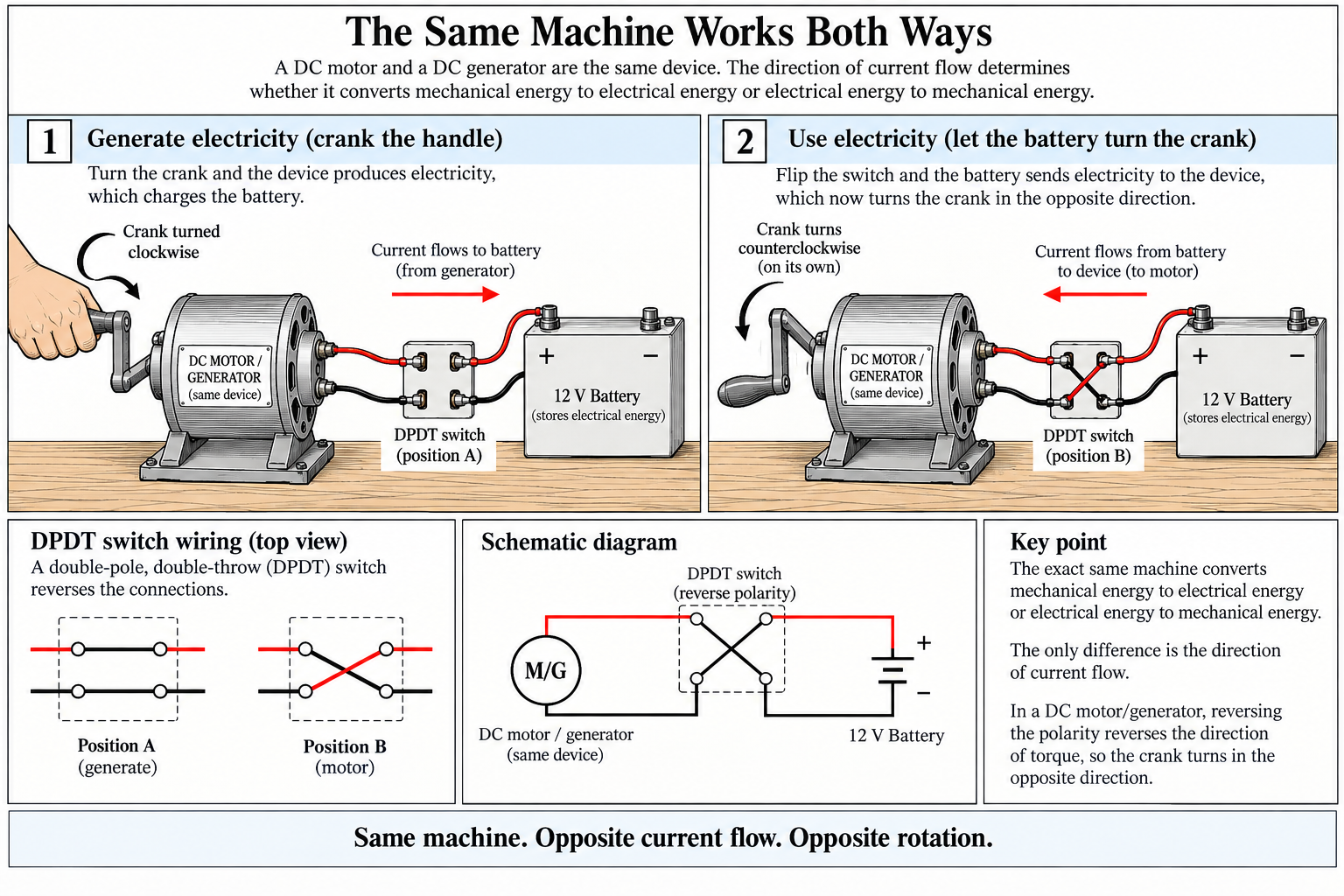
Your perceptual system does something analogous. External sensory activity drives the system into a particular physical state when you see a fighter jet. When you imagine the jet aircraft, internally generated activity (hallucination) drives overlapping perceptual machinery into part of that state again. The representation isn't being sent to some separate screen inside your head. The machinery that normally participates in receiving the perception is itself being driven into the perceptual state.
Reality enters through constraint (Light enters through the wound - Rumi)
It's important to note that I am not claiming some goofy shit like the external world is imaginary or that "we live in a simulation" a la the matrix. The external world is what keeps the hallucination constrained or not depending on personal psychosis.
Two people can generate independent internal worlds and agree that a red ball is sitting on a table in front of them because both hallucinations are being continuously constrained by a common external process. I can move the ball and your experience changes because we have a shared reference and shared reality ideally emerges from that convergence.
We already measure the hallucinations
What I describe is effectively the existing known literature on data processing and streaming data in the biological systems since the early 2000s. Francis Crick, who won the Nobel Prize for discovering DNA, spent the last part of his life studying consciousness and argued that visual consciousness could be investigated through the neural processes constructing perceptual representations.1 Twenty years of subsequent work has made that construction measurable.
Churchland and Shenoy describe neural populations occupying an “output-null” space in which the coming action can be represented without producing the corresponding movement.2 Motor cortex enters task-specific preparatory states before movement occurs demonstrating that the organism has physically entered a state appropriate to an action that has not happened.
During REM sleep motor commands in sleeping mice were recorded corresponding to movements through their environment. The movements were not executed, while the animals’ internal representation of direction changed as though they had been.3 The nervous system generated an action and propagated its expected consequence into the internally represented world without requiring the external action.
Rats encountering a novel detour rapidly produced hippocampal sequences using neuronal sequence motifs expressed during sleep before encountering the detour.4 The physical system had already generated components that could be recombined into a representation extending beyond its current sensory state.
Even the apparent stability of vision depends on the relationship between generated state and expected action. Your eyes make rapid saccades that repeatedly move the retinal image while the world you experience remains largely stable. Rolfs and colleagues found across five preregistered experiments that limits of high-speed perception follow the kinematics of saccadic eye movements even when the corresponding movement is absent.5
These experiments are increasingly measuring the physical rollout itself. Neural systems enter states appropriate to actions, perceptions and consequences that are not currently being supplied by the world, then use subsequent information to constrain what happens next.
Change the hallucination and the world changes with it
Centuries of observations of people utilizing psychedelics make all of this blisteringly obvious the external environment can remain unchanged while the user's experienced scene changes dramatically and here everyone is excited to use the word Hallucination. LSD-induced visual hallucination corresponds to measurable changes in visual cortex activity and connectivity.6 Work with psilocybin similarly finds altered dynamics associated with internally generated visual imagery.7 The changed world being experienced corresponds to a changed physical state of the system generating it.
Dreaming demonstrates the same principle without drugs. The external visual stream largely disappears while an experienced environment continues. You move through spaces, encounter objects and experience events because the machinery capable of generating those states remains active without its ordinary degree of external constraint - much like the old gorilla crossing video
General anesthesia operates in the inverse process. Sensory processing can persist while the large-scale dynamics associated with coherent conscious experience dissolve.8 Information arriving at a nervous system is insufficient by itself to explain the experienced world. The system has to maintain the internally generated state into which that information is incorporated.
Most of the time this construction is invisible precisely because its output is what you experience.
Meditation provides one way to notice parts of it. With practice, sensations and thoughts can become perceptible as events entering and leaving experience, and attention itself becomes something whose movement through those events can be observed. Research on meditation describes trainable changes in attention regulation and monitoring consistent with that experience.9
I have also had a less voluntary opportunity to observe it as I developed epilepsy as an adult. I was lucky that I already had decades of significant work in meditation, which gave me tools to interrogate my perception and I had already developed stream inference thesis years before my first seizure, so the model did not come from trying to explain epilepsy. What seizures gave me was the experience of processes I had modeled abstractly separating and recombining.
During seizures I have experienced visual information, other sensory information, spatial relationships, memory and attention stop arriving as a single coherent world. In some cases I retained vivid enough memories afterward to reconstruct aspects of the sequence in which those processes separated and returned. Processes that ordinarily disappear into the unified experience became individually perceptible because their coordination was failing. I had modeled intelligence as inferred streams continuously generating their expected continuation. I could now experience what happened when streams normally presented as a single reality stopped combining correctly and a coherent hallucination can become incoherent while you are still inside it.
People have been observing this for thousands of years
This is also why so much of the language surrounding meditation and Buddhism sounds familiar once consciousness is described as a continuously generated process.
The various Buddhist traditions differ substantially in terminology and metaphysics, but sustained contemplative practice repeatedly produces observations that experience changes continuously and that sensations, perceptions, thoughts and the apparent unity of the self can be observed as processes arising under conditions. Mindfulness makes those processes objects of attention rather than leaving the practitioner entirely inside their contents.
Why I don’t spend time arguing about consciousness
Consciousness debate reduces to a definitional holy war, and I don’t find any war but class war interesting.
There are many competing definitions of consciousness, and after enough discussion the disagreement usually stops being empirical because the participants are no longer talking about the same conceptual object. global availability, recurrent processing, integrated information, higher-order representation etc... and irreducible phenomenal experience generate different experimental programs because each has already put a different definition into the experiment. Too many definitions carry entire epistemological frameworks behind them, and changing the definition can invalidate the question someone has spent a career learning how to answer. People are not consistently behaving scientifically around that boundary, and I have little interest in spending my time adjudicating it.
Beyond that almost all of these hypotheses produce an enormous amount of machinery that is speculative or non-measurable. The history of science gives me little reason to prefer complexity when a simpler physical mechanism already explains the observation. Elaborate mechanisms invented to preserve an existing conceptual distinction have a habit of disappearing once the underlying phenomenon can be described more directly.
We already know that nervous systems physically generate perceptual states in the absence of their corresponding external inputs. We can measure those systems preparing actions before they occur and propagating internally generated consequences when the actions never happen. We can chemically perturb the generated world, watch it continue during dreams and disrupt its coherence under anesthesia. None of this requires a second process that receives the generated state and turns it into experience.
I also don’t expect thisto convince anyone and I didn't write it for that. I’m writing this because I get asked what I think consciousness is often enough that I want the answer written down cause I'm lazy and really don't like constantly repeating myself.
Consciousness is the ongoing physical hallucination generated by an organism modeling itself in a world.
Its coherence depends on constraint, and what we call shared reality appears when independently generated worlds remain sufficiently constrained by the same external processes to continue agreeing with one another. Once that shared structure falls far enough, even alignment between agents eventually becomes mechanically impossible.
Modern neuroscience can increasingly measure pieces of this process from outside while contemplative traditions demonstrate systems can learn to observe pieces of the perception from inside the hallucination.
Finally, for anyone reading this that wants to collapse it into: "Andrew says Hallucinations are consciousness therefore LLMs are conscious because they hallucinate" -- please understand not only are you wrong but you are contemptuous for making such an ignorant claim.
References
[1] Francis Crick & Christof Koch. “A Framework for Consciousness.” Nature Neuroscience (2003).
[2] Mark Churchland & Krishna Shenoy. “Preparatory Activity and the Expansive Null-Space.” Nature Reviews Neuroscience (2024).
[3] Yuta Senzai & Massimo Scanziani. “The Brain Simulates Actions and Their Consequences During REM Sleep.” (2024).
[4] Zhou, Sibille & Dragoi. “Generative Emergence of Non-Local Representations in the Hippocampus.” Nature Communications (2025).
[5] Rolfs et al. “Lawful Kinematics Link Eye Movements to the Limits of High-Speed Perception.” Nature Communications (2025).
[6] Carhart-Harris et al. “Neural Correlates of the LSD Experience Revealed by Multimodal Neuroimaging.” PNAS (2016).
[7] Singleton et al. “Neural Mechanisms of Psychedelic Visual Imagery.” Molecular Psychiatry (2024).
[8] George Mashour. “Anesthesia and the Neurobiology of Consciousness.” Neuron (2024).
[9] Lutz, Slagter, Dunne & Davidson. “Attention Regulation and Monitoring in Meditation.” Trends in Cognitive Sciences (2008).